
Sentiment Analysis
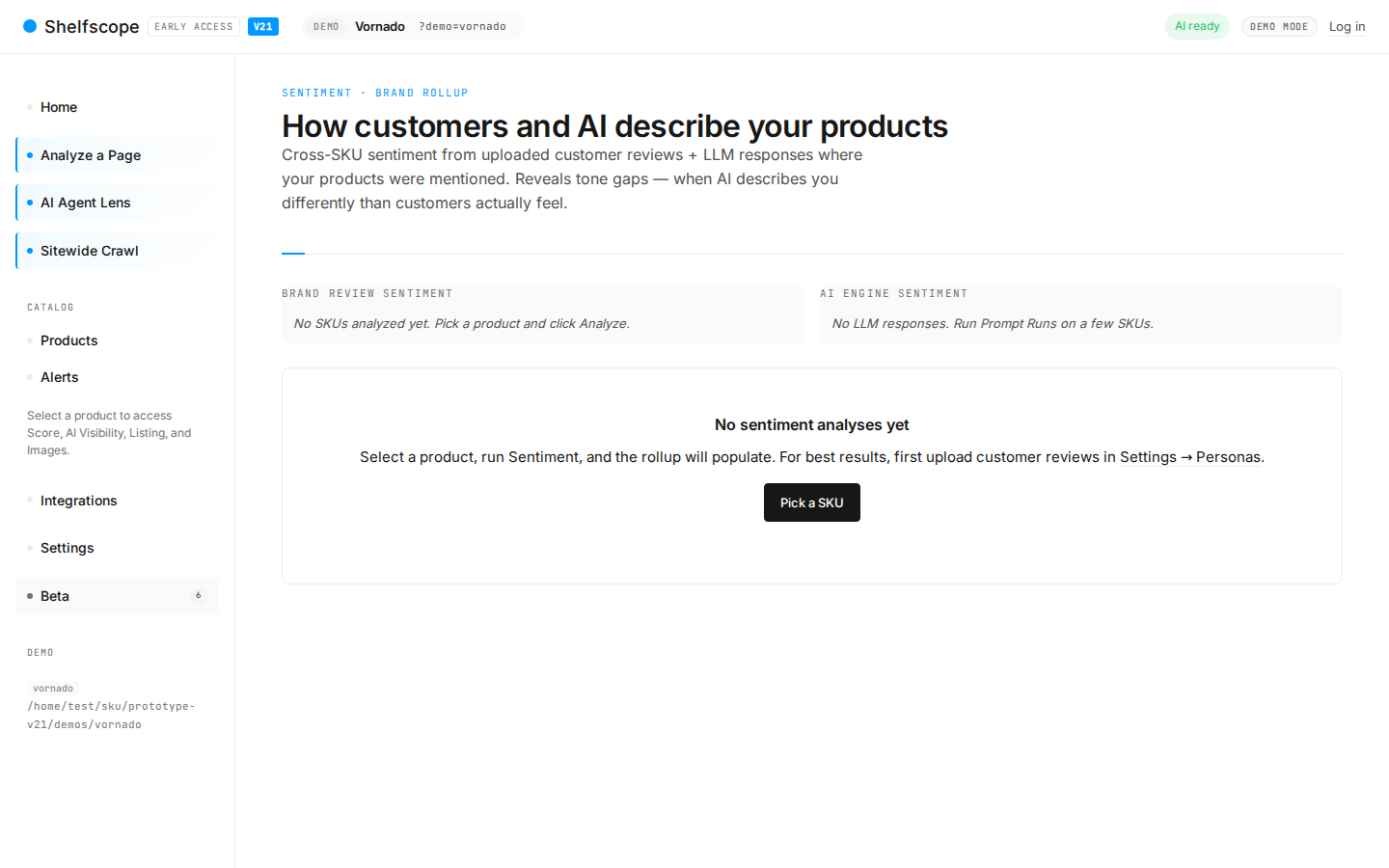
Sentiment Analysis surfaces the themes hidden in your reviews, compares the tone of your reviews with the tone of AI engine responses about your brand, and flags the gaps. Both per-SKU breakdowns and brand-wide rollups are available.
What it does
Three jobs.
- Pull every review you have. Cluster the themes. Quantify polarity.
- Write a short voice-of-customer paragraph in your customers' actual language.
- Compare that paragraph with how AI engines currently describe your brand. Flag the gap.
The third job is the one that matters most. If an engine describes you in a tone your customers don't use, you have a citation risk: the click-through experience sounds inauthentic, and the engine eventually drifts to a more authentic competitor.
Theme extraction
The clusterer runs over your review corpus and produces a ranked list of themes, each with a polarity (positive / negative / mixed) and a sample of three quoted reviews. Themes are not the same as features — they include emotional and contextual themes ("gift-giving moment," "first apartment," "noise sensitivity") that pure feature tagging misses.
Voice-of-customer rollup
Three to five sentences. Written in the actual vocabulary of your customers, paraphrased to avoid quoting any single review verbatim. The rollup is generated per SKU and per brand. Brand-wide rollups are particularly useful for the company About page and for the prompt-prefix in Listing rewrite.
Tone-gap detection
This is the comparison that drives action. eCommerce Insights takes the voice-of-customer paragraph and the AI engine descriptions of your brand (drawn from Prompt Runs) and runs a side-by-side comparison.
The output is a list of gaps, each with a severity and a suggested remediation. Two common patterns:
- Tone-up — the engine describes the brand more formally than customers do. The product feels distant. Remediation: tone-down language in PDP copy, especially in the lede paragraph.
- Tone-down — the engine omits emotional language that customers consistently use. The product feels generic. Remediation: surface customer-language phrases in bullets and FAQ.
Per-SKU vs brand-wide
Both views available. Per-SKU is where you act. Brand-wide is where you spot patterns (a tone-gap that shows up on multiple SKUs is usually a content-template problem, not a per-SKU one).
Inputs
| Source | Method | Auto-refresh |
|---|---|---|
| Yotpo | API or CSV export | Hourly (API); on upload (CSV) |
| Judge.me | API or CSV export | Hourly (API); on upload (CSV) |
| Okendo | CSV export | On upload |
| Trustpilot | CSV export | On upload |
| Stamped | CSV export | On upload |
| Reviews.io | CSV export | On upload |
| Amazon reviews | Public listing scrape | Weekly |
Common questions
What review sources does it accept?
How is the tone gap useful?
Can it handle reviews in multiple languages?
How often does it run?
Ask AI about this page
Open this topic directly in your favourite AI assistant — the prompt is prefilled.
Try this yourself
See eCommerce Insights on your own catalog. The free trial covers your full SKU set across five AI engines, no credit card required.
Start free trial