
Get cited in AI search. Get agent-ready.
Track which products ChatGPT, Perplexity, and Google AI Overviews recommend. Fix the PDPs they skip — and make every one readable to the shopping agents filling carts. Push the changes to your catalog. Built for Shopify and D2C brands on every ecommerce channel.





Your SEO ledger has a missing column.
Ranking on Google gets you the click. Getting cited in ChatGPT or Perplexity gets you the consideration. Most brands can audit the first to the keyword — and cannot see the second at all.
AI engines don't crawl like Google.
ChatGPT, Perplexity, and Google AI Overviews synthesize a handful of sources per answer — Perplexity typically cites 3–7. Rank #1 on Google and you can still be absent from the answer because the engine picked a review blog, a Reddit thread, and one competitor's PDP.
Brand-level tracking misses SKUs.
Most AI visibility tools report whether your brand was mentioned. That isn't the unit of revenue. Your best-seller or your clearance SKU — which one is in the answer? A brand ping can't say. See how SKU-level differs from Profound.
Audits without fixes are noise.
You need per-SKU scores and concrete PDP changes — title, description, bullets, schema, metafields — your team can ship this week. eCommerce Insights outputs diffs, not dashboards of "needs improvement" labels. See PDP optimization.
Track citations. Score agent-readability. Ship the fix.
Two scores per SKU: one for whether AI engines cite the product in shopping research, one for whether a shopping agent can parse the PDP cleanly enough to recommend it or draft it into a cart. Both improve with the same fixes — pushed straight to your catalog.
Every SKU, every engine, every week.
eCommerce Insights connects to your catalog and scans it across ChatGPT, Perplexity, Google AI Overviews, Gemini, Claude, and Copilot. Each SKU gets a per-engine ledger entry: which queries it appeared on, which sources were cited alongside it, and how the engine phrased the recommendation. Weekly on Starter, daily on Growth.
Query: "best merino base layer for cold-weather running, men's medium"
- Structured data
- 92 / 100
- Citation surface
- 78 / 100
- Entity clarity
- 88 / 100
- Answer coverage
- 71 / 100
- Review signal
- 85 / 100
A citation score and an agent-readability score for every PDP.
The citation score — structured data, citation surface, entity clarity, answer coverage, review signal — explains why engines aren't recommending the product. The agent-readability score — Product JSON-LD completeness, robots.txt admittance, machine-readable price and availability, discoverable returns and shipping policies, agentic-checkout wiring where applicable — tells you whether ChatGPT Shopping or Perplexity Buy with Pro can parse the PDP well enough to draft it into a cart. Score methodology →
Concrete diffs, pushed to your catalog.
For each SKU below your threshold, eCommerce Insights produces a diff: proposed title, description, bullet set, schema block, and metafield values. A merchandiser reviews, edits, approves. The change lands in Shopify through the admin API — or exports as CSV if you'd rather ship it yourself. Shopify push · Early access
The buyer's journey grew a step you can't see.
Before the click, there's now an answer. Before the cart, there's now an agent. Each row below is a surface where your products win or lose without a single session in your analytics.
Channel-aware audits for any ecommerce platform.
Shopify
SKU-level audits, JSON-LD diffs, metafield recommendations. Push approved changes via the Admin API.
See Shopify use case →Amazon
Rufus + COSMO scoring across all 15 commonsense intent relations. Title, bullets, A+ Content, and backend keyword rewrites for Seller Central.
See Amazon use case →Other channels
Adobe Commerce, BigCommerce, WooCommerce, and headless storefronts. Same channel-aware engine, vendor-specific recommendations.
See all 6 channels →Six surfaces. One ledger for AI visibility.
PDP Score
Five buckets × 25 criteria. Channel-aware — Amazon SKUs route to Rufus.
Read docs →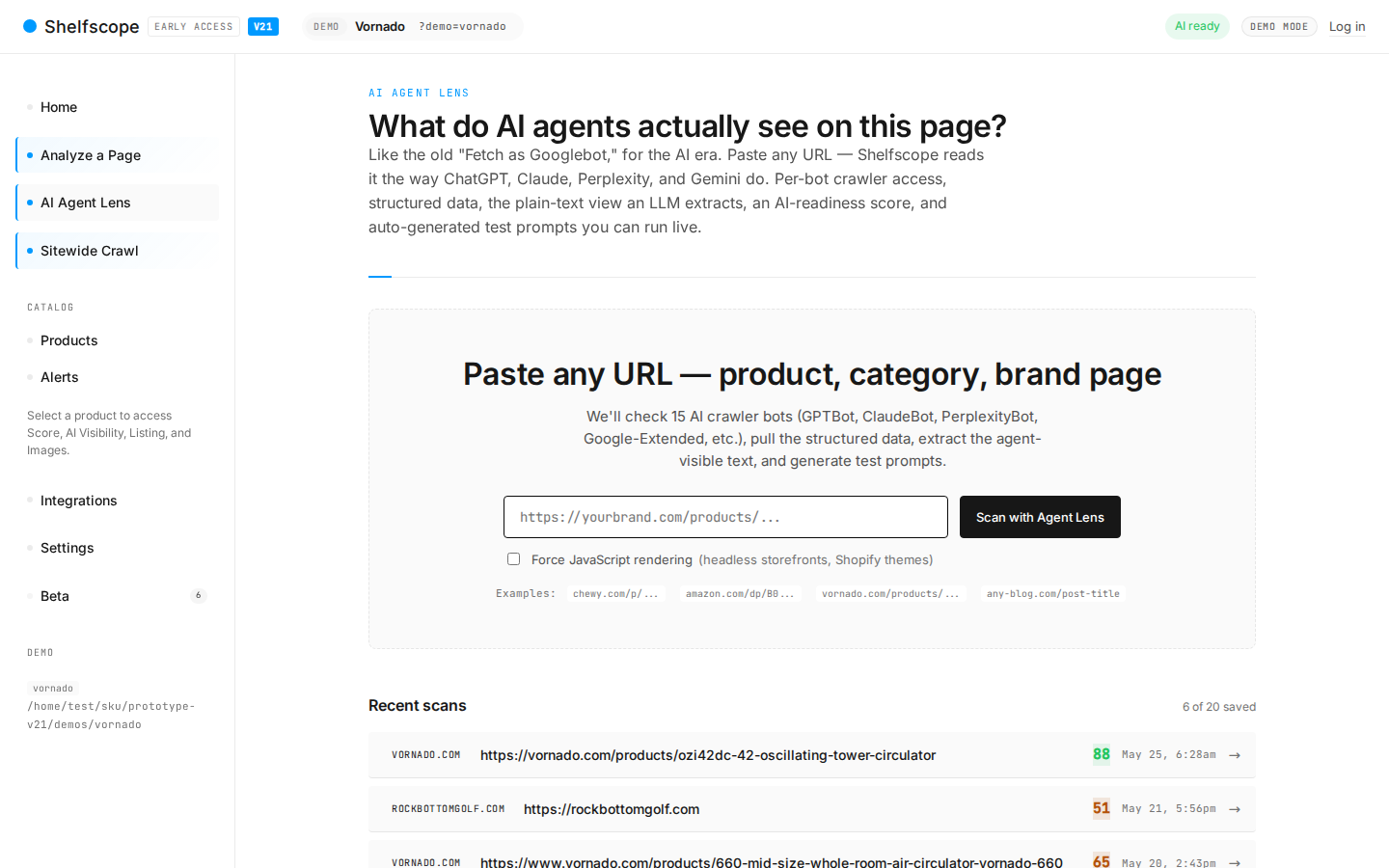
AI Agent Lens
15 AI bots evaluated against your robots.txt. Plain-text view. Auto-generated test prompts.
Read docs →
Prompt Runs
Side-by-side prompts against ChatGPT, Claude, Gemini, Perplexity, Copilot, and Grok.
Read docs →
Listing rewrite
Per-field capsules with green/red diffs. JSON-LD additions. Shopify metafield recommendations.
Read docs →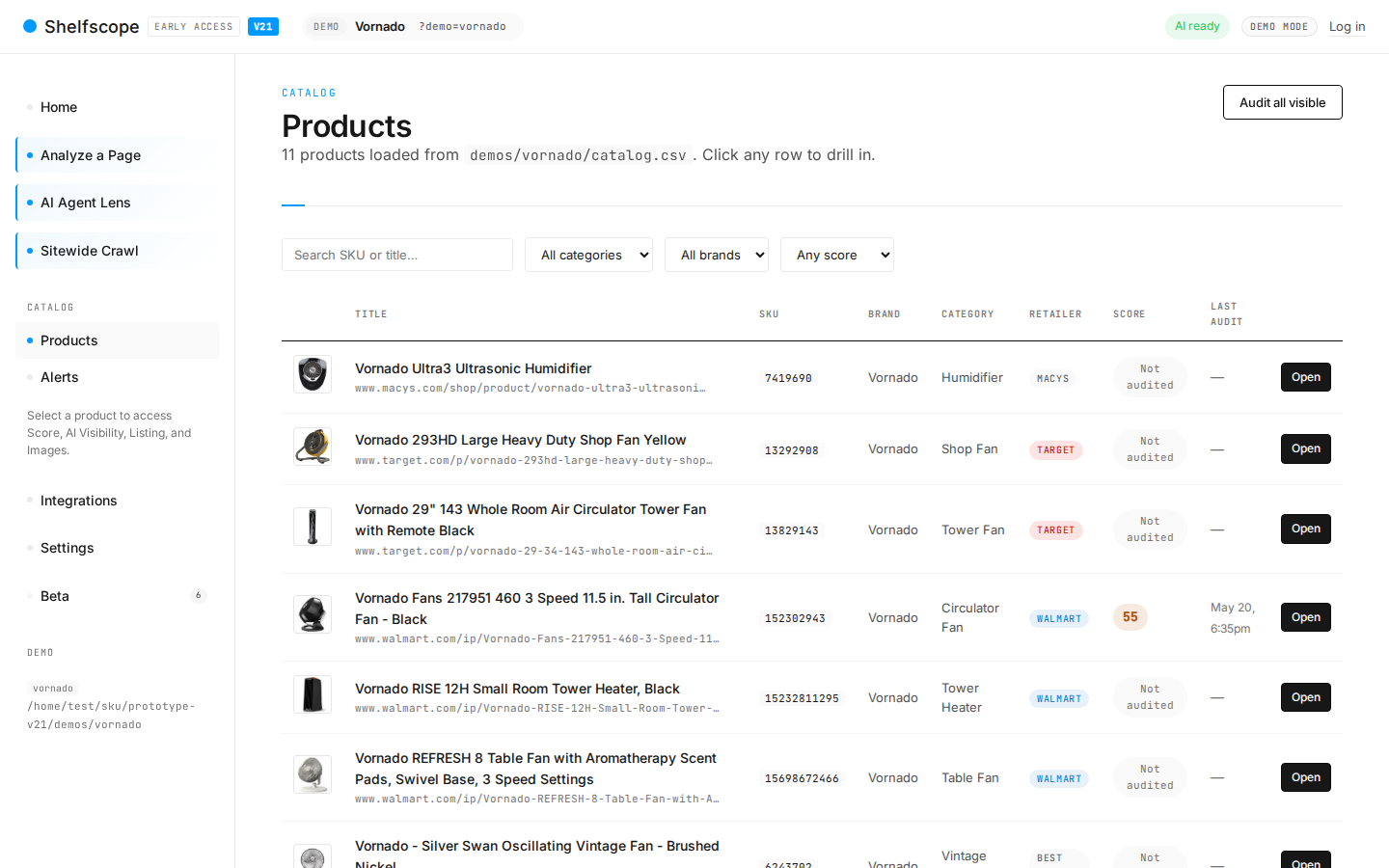
Image Enhancer
Feature sentiment mapping, mobile glanceability, competitive benchmarking, AI creative brief.
Read docs →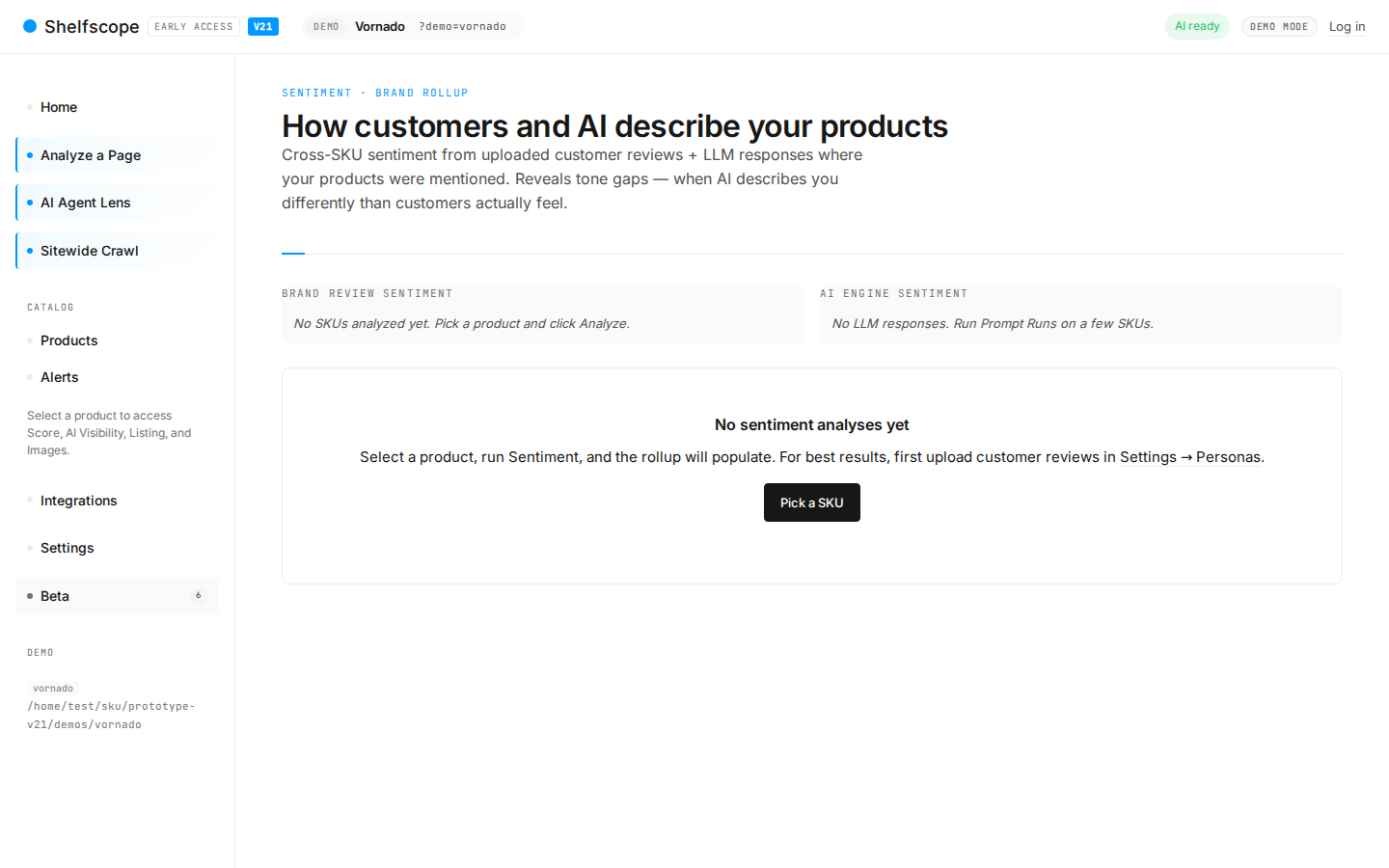
Sentiment
Themes from real reviews, plus the tone gap between customer sentiment and AI engine descriptions.
Read docs →How much revenue is AI search worth to your catalog?
Plug in your numbers. Conservative model based on COSMO research and reported AI-traffic growth. Estimates, not promises.
Estimate based on category research, not your specific store. Assumes optimized PDPs lift AI-engine citation rate by 35%, per Amazon Science's COSMO paper and internal benchmarks. Real results vary.
Built for catalogs. Priced for D2C.
Not an enterprise catalog suite, not a generalist SEO platform, not a brand-tracker. The unit of analysis is the SKU, because that's the unit of revenue.
They track your brand. We track your SKUs.
Profound, Brandlight, Otterly, and Peec count brand mentions. Useful — until you ask which product got picked, on which query, and what to change. eCommerce Insights resolves every answer to SKU and query.
They run procurement cycles. We run a free trial.
ReFiBuy and the other enterprise catalog platforms sell through sales cycles with on-request pricing. Strong for Fortune-500 catalogs; heavy for a $5M–$200M brand. eCommerce Insights is self-serve, connected to your store in minutes, priced like the SaaS in your existing stack.
They added AI visibility. We started with it.
Ahrefs Brand Radar and Semrush's AI Visibility Toolkit bolt AI tracking onto keyword platforms. The primitive here is the SKU — every feature resolves to a product, not a keyword cluster.
Brand-level AI tracking is a report. SKU-level tracking is a plan.
The six engines that move D2C consideration.
Every scan runs across all six. Ordered by D2C relevance, not alphabet.
ChatGPT
Including ChatGPT Shopping and Instant Checkout. Highest query volume for D2C discovery.
Perplexity
Including Perplexity Shopping and Buy with Pro. Cites 3–7 sources per shopping answer.
Google AI Overviews
Plus AI Mode. The most consequential surface for Google-dependent brands.
Gemini
Google's standalone assistant. Different citation behavior than AI Overviews — track both.
Claude
Anthropic's assistant. Strong on long-form product research queries.
Copilot
Microsoft Copilot across Bing, Edge, and Windows. Underweighted in most tracking tools.
Rufus (Amazon) and Sparky (Walmart) covered on channel plans — see all engines.
Grade your catalog in 90 seconds.
Paste your store URL. eCommerce Insights checks five products across ChatGPT, Perplexity, and Google AI Overviews, then emails you a scored report. No signup required.
Frequently asked questions
What does eCommerce Insights actually track?
How is SKU-level tracking different from brand-level tools like Profound or Peec?
How are AI agents using ecommerce stores in 2026 — research, draft carts, or full checkout?
Does eCommerce Insights work with Shopify Plus?
Can eCommerce Insights push changes directly to my store?
What does eCommerce Insights cost?
Ask AI about eCommerce Insights
Have your favorite AI engine summarize what eCommerce Insights does for your use case.
See your catalog the way AI sees it.
14-day free trial. No credit card. Connect your store in under five minutes.