Starter
$99/ mo
- Up to 500 products tracked
- Weekly refresh, six engines

Product-level AI visibility · ecommerce AEO
Your buyers ask ChatGPT, Perplexity, Google AI Overviews, Gemini, Claude, and Copilot what to buy before they reach your store. eCommerce Insights tracks which of your products those answers cite, scores every PDP twice — citation and agent-readability — and ships the title, schema, and metafield fixes as diffs a human approves.
How it works
No onboarding project, no services engagement. Connect, scan, read the two scores, approve the diffs.
Connect Shopify through the admin API, or link Amazon, Adobe Commerce, BigCommerce, WooCommerce, or a headless storefront. Catalog, variants, and metafields are read in under five minutes. No developer required.
Every SKU runs against a category-tuned prompt bank across ChatGPT, Perplexity, Google AI Overviews, Gemini, Claude, and Copilot. First results within 24 hours; weekly refresh on Starter, daily on Growth.
Each SKU gets a citation score (is the engine recommending it) and an agent-readability score (can a shopping agent parse the PDP). Every sub-factor is visible, so the score is a work queue, not a verdict.
Each failing SKU gets a reviewable diff: proposed title, description, bullets, schema, and metafield values. A human approves; eCommerce Insights pushes to Shopify Early access or exports CSV for every other channel.
Brand-level trackers tell you the brand was mentioned. eCommerce Insights resolves every AI answer to a specific SKU, a specific prompt, and a specific engine — because "the brand showed up" doesn't tell you whether the answer recommended your best-seller or your clearance bin.
Each scan runs a rotating, category-tuned prompt bank and records which SKU was cited, which sources were cited alongside it, and how the engine phrased the recommendation. Prompts are generated from your collections and best-sellers, then rotated each scan, and segmented by intent: "best" behaves differently from "cheapest," "gift for," and "alternative to."
Starter refreshes weekly; Growth refreshes daily. Co-citation data shows the real competitive set per query — often review sites and Reddit threads, not the competitors in your deck. Full methodology on the SKU-level tracking page.
| Engine | Status | Citations |
|---|---|---|
| ChatGPT | Cited | 3 |
| Perplexity | Cited | 1 |
| Google AI Overviews | Missing | 0 |
| Gemini | Missing | 0 |
| Claude | Cited | 2 |
| Copilot | Cited | 1 |
Co-cited sources: rei.com, outdoorgearlab.com, reddit.com/r/ultralight. Illustrative.
Capability · Score
One worked example, factor by factor. MERINO-BL-MD is an illustrative SKU — a merino wool base layer, men's medium — but the factors and the failure modes are exactly what every scan reports.
| Factor | Score |
|---|---|
| Structured data completeness — Product schema fields present | 16 / 20 |
| Citation surface — citations vs catalog peers on the prompt set | 11 / 20 |
| Entity clarity — brand consistency, canonical URL, title specificity | 15 / 20 |
| Answer coverage — does the PDP answer the top buyer questions | 13 / 20 |
| Review signal — volume, recency, review schema surfacing | 16 / 20 |
Diagnosis: the PDP is well structured but rarely cited — the prompt set routes to review sites because the page doesn't answer "fits true to size?" or "how warm is 200gsm?"
| Factor | Score |
|---|---|
| Product JSON-LD completeness — 8 of 11 recommended fields | 17 / 25 |
| robots.txt admittance — Google-Extended blocked | 15 / 20 |
| Machine-readable price and availability in offers | 16 / 20 |
| Discoverable returns and shipping policies | 10 / 20 |
| Agentic-checkout wiring (ACP/UCP feeds, where applicable) | 6 / 15 |
Diagnosis: a shopping agent can find the price but not the returns policy, and one AI crawler is blocked outright. Both fixes ship in the same diff.
Illustrative scores for a hypothetical SKU. Real scores come from live scans. Methodology: citation score · agent-readability score · PDP Score docs.
For every SKU below the threshold you set, eCommerce Insights produces a diff: proposed title, description, bullet set, schema block, and metafield values, shown next to what's live today. A merchandiser reviews, edits, and approves. Nothing ships without a human decision.
On Shopify, approval can push the change straight through the admin API — including metafield writes for GTIN, material, and the rest of the Product schema, in the correct namespace. Shopify push · Early access Every push is logged, attributed to the approver, and reversible in one click.
On Amazon, the diff covers title, bullets, A+ Content, and backend keywords for Seller Central. On every other channel, and on every plan, approved diffs export as CSV. More on the workflow: PDP optimization and the listing rewrite docs.
PDP diff · MERINO-BL-MD score +14
title
- Merino Base Layer Men's Medium
+ Merino Wool Base Layer for Men, Medium
+ — 200gsm, Cold Weather
body
+ "Fits true to size" answer added
+ Care instructions (machine wash cold)
schema.Product
+ gtin: 00860009123456
+ material: "100% merino wool"
+ hasMerchantReturnPolicy: 30-day returns
metafield: custom.gtin
+ 00860009123456Illustrative diff. Real diffs are generated from the scan and your live PDP.
Channel-aware engine
A Shopify metafield recommendation is useless on Amazon; a backend-keyword rewrite is useless on Shopify. The scoring engine routes every product by channel.
Shopify SKUs run the full six-engine scan and get diffs that speak Shopify: titles, body HTML, Product JSON-LD, and metafield values in the right namespace. Variants are read and scored where engines cite specific sizes or colors. Push lands through the admin API on Growth and up. AI visibility for Shopify →
Amazon SKUs route to Rufus and Amazon's COSMO model, scored across its 15 commonsense intent relations — the "used for," "worn with," "bought for" links between products and buyer intent. Recommendations cover title, bullets, A+ Content, and backend keywords for Seller Central. AI visibility for Amazon →
Adobe Commerce, BigCommerce, WooCommerce, and headless storefronts get the same six-engine scan with vendor-specific recommendations. See all six channels.
Inside the platform
Every feature resolves to a SKU, a prompt, and an engine. Documentation for each is public — read it before you trial.
The two-score model per SKU. Channel-aware — Amazon SKUs route to Rufus/COSMO.
Read docs →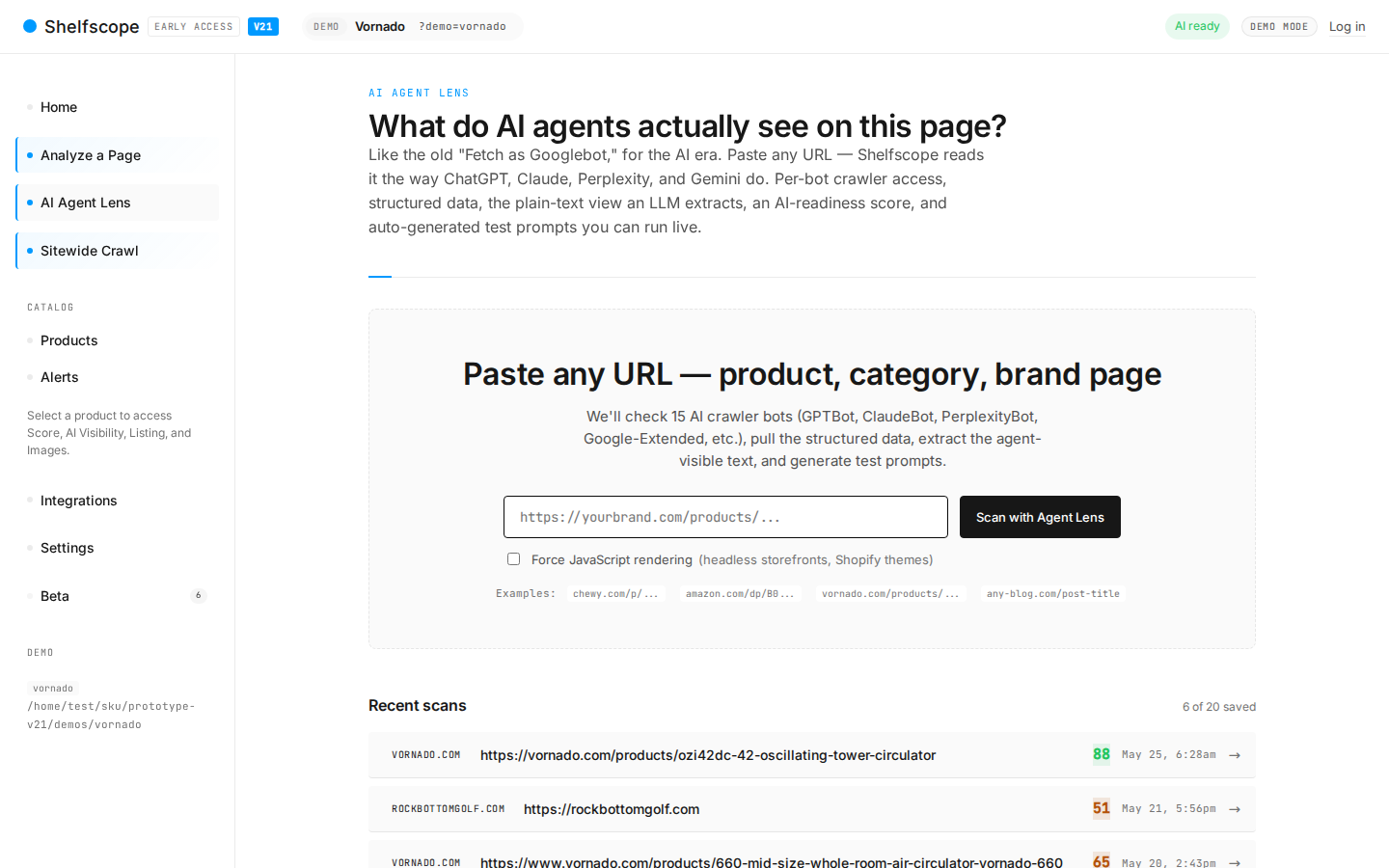
15 AI bots checked against your robots.txt, plus the plain-text view an agent actually parses.
Read docs →
Run the same buyer prompt across engines side by side and see who gets cited.
Read docs →
Per-field diff capsules: title, body, JSON-LD additions, Shopify metafield values.
Read docs →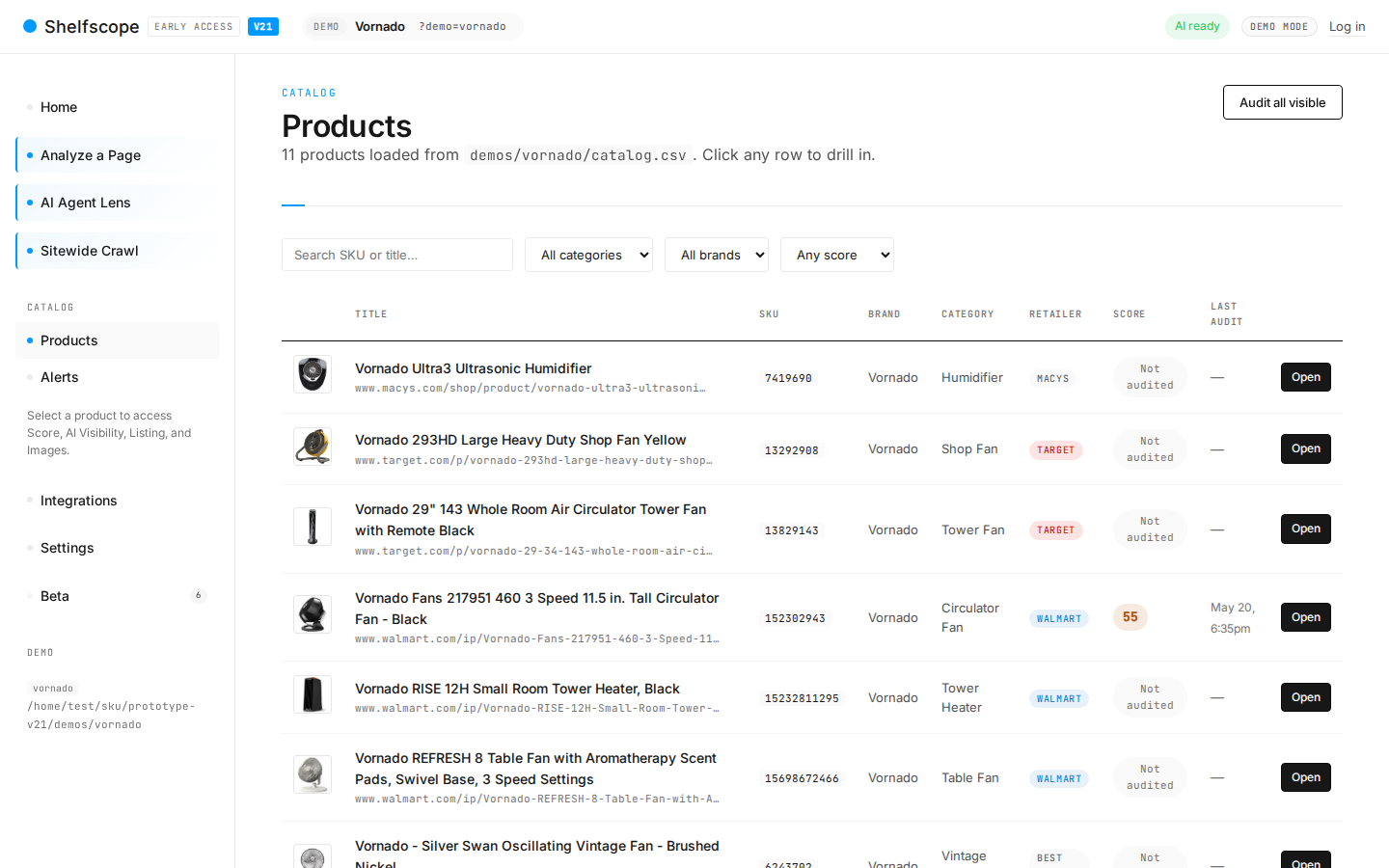
Feature-sentiment mapping, mobile glanceability, competitive benchmarking, creative brief.
Read docs →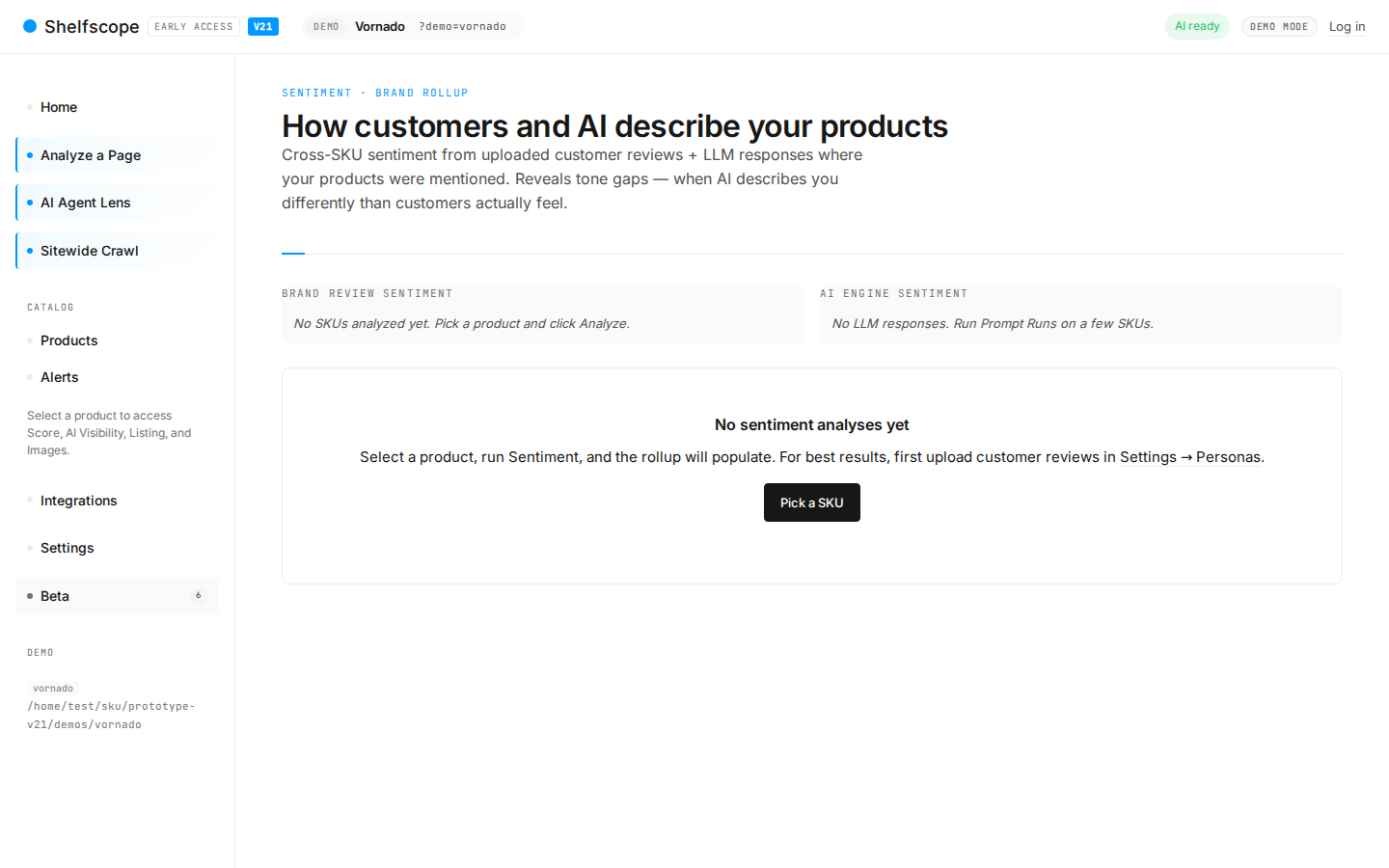
Themes from real reviews, and the tone gap between customer sentiment and AI descriptions.
Read docs →Integrations
Agency & Enterprise plans add multi-brand dashboards, per-client seats, and white-labeled reports (Early access). One login, every client catalog, a baseline report in week one. See for agencies and for multi-brand portfolios.
Pricing
Six engines on every plan: ChatGPT (including ChatGPT Shopping and Instant Checkout), Perplexity (including Perplexity Shopping and Buy with Pro), Google AI Overviews and AI Mode, Gemini, Claude, and Copilot. SKUs on a connected Amazon channel are also scored against Rufus and the COSMO intent model; Sparky (Walmart) is available on Agency & Enterprise plans.
Five factors per PDP: Product JSON-LD completeness, robots.txt admittance for AI crawlers, machine-readable price and availability, discoverable returns and shipping policies, and agentic-checkout wiring where applicable. Each factor is reported separately with the specific fields or bots that failed, so the fix is obvious from the score.
Five weighted factors, refreshed with every scan: structured data completeness, citation surface (how often the SKU is cited on the tracked prompt set), entity clarity, answer coverage (whether the PDP answers the category's top buyer questions), and review signal. Every sub-score is visible per SKU, per engine.
No. Every recommendation ships as a reviewable diff — proposed title, description, bullet set, schema block, or metafield value shown next to the current one. A human on your team reviews, edits, and approves before anything changes. Bulk approval exists for similar diffs, but the review step never disappears.
Both. On Shopify, approved diffs push through the admin API on the Growth plan and up (Early access); every write is logged, attributed to the approver, and reversible. On every other channel, and on every plan, approved diffs export as CSV your team can ship through its own workflow.
Yes. eCommerce Insights is Shopify-first but channel-aware: Amazon catalogs get Rufus and COSMO scoring with A+ Content and backend-keyword recommendations, and Adobe Commerce, BigCommerce, WooCommerce, and headless storefronts get the six-engine scan with vendor-specific output. Recommendations always match the channel they ship to.
Reference: the diffs recommend against the schema.org Product vocabulary — the same structured data AI engines and shopping agents parse.
Ready when you are
14-day free trial. Six engines. No credit card.
2,500 products · 6 engines · daily refresh on Growth